Fuelling a Marathon: Stop Hitting the Wall and Start Crossing the Finish Line
Mile 20. The crowd is thinning. Your legs feel like they’ve been replaced with two damp sandbags. And somewhere deep in your gut, a civil war is breaking out between the three gels you’ve panic-swallowed and the isotonic drink you grabbed at the last station. Sound familiar? That, my friend, is what happens when fuelling a marathon goes wrong. The good news: it doesn’t have to. The slightly annoying news: you need a plan, and you need to practise it on your Sunday Long Run before race day turns into a very public digestive emergency.
This guide covers everything – gels, carb-loading, electrolytes, and why your stomach absolutely hates you at mile 20. Let’s sort it out.
Why Fuelling a Marathon Is Not Optional
Your body stores roughly 90 minutes of glycogen at marathon pace. That’s it. After that, you’re running on fumes, prayer, and whatever a spectator is waving at the roadside (usually a banana or a Jelly Baby, bless them). According to Runner’s World, most runners need between 30 and 60 grams of carbohydrate per hour during a marathon, rising to 90g per hour for faster athletes using multiple carb sources.
If you skip this? You hit the wall. The wall is not a metaphor. It’s your body politely shutting down non-essential services and suggesting you sit on a kerb. We’ve all been there. Some of us have photos.
How Much Fuel Do You Actually Need?
A rough rule of thumb: take on a gel or equivalent every 30 to 45 minutes from around the 45-minute mark. For a 4-hour marathon that’s roughly 6 to 7 gels across the race. Most gels contain 20 to 25g of carbs, so that lines up neatly with the 30 to 60g per hour target. Always wash them down with water, not sports drink – combining the two can spike the sugar load and send your gut into full revolt mode.
- Start fuelling early – don’t wait until you feel hungry. By then, it’s too late.
- Practise your exact race-day gel brand and flavour on your long runs. No heroics on race day with an untested product.
- Carry gels in a small running belt or tuck them into your shorts. Losing one at mile 10 is a special kind of misery.
- If you’re using race-provided gels, find out the brand in advance and train with them.
The Great Gel Debate: Industrial Wallpaper Paste vs. Actual Food
Let’s be honest about gels. They are not a culinary experience. The texture sits somewhere between wallpaper paste and the stuff you used to make papier-mache in Year 4. And yet, here we are, squeezing them into our faces at 8am on a towpath in November. Such is the glamour of the sport.
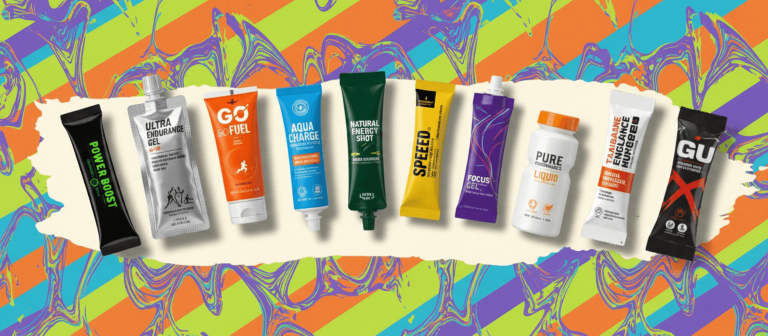
That said, texture and tolerance vary a lot between brands. UK runners tend to gravitate towards a few reliable options:
- SiS (Science in Sport) Go Isotonic Gels – UK-made, thinner consistency, no water needed. Widely available at running shops and online. A solid staple for club runners.
- Maurten 100 – the hydrogel tech option, gentler on the stomach for many runners. On the pricier side, but worth trialling if your gut has a history of kicking off.
- High5 Energy Gels – UK brand, decent flavour range, reasonably priced. Good for long run practice.
- Torq Energy Gels – another British brand, natural ingredients, slightly less cloying than some competitors.
Check out our guide to the cheapest running gels if your wallet is wincing at the thought of buying 20 gels for one race block.
Carb-Loading: The One Part of Marathon Training Everyone Enjoys
Carb-loading is, let’s be clear, an excellent concept. The idea that eating large amounts of pasta and pizza is a legitimate athletic strategy is one of running’s greatest gifts to humanity. The reality is slightly more nuanced, but not by much.
True carb-loading means increasing your carbohydrate intake to around 8 to 10 grams per kilogram of body weight in the 2 to 3 days before your marathon. For a 70kg runner that’s 560 to 700g of carbs per day. That is, genuinely, a lot of pasta. The goal is to top up your glycogen stores so you start the race with a full tank rather than a half-empty one.
A few practical points:
- Keep fat and fibre low in the final 48 hours – both slow digestion and can cause, shall we say, race-morning complications.
- Don’t try new foods. Now is not the time to discover you don’t tolerate a particular sauce.
- Hydrate well but don’t overdo it – hyponatremia (low sodium from drinking too much plain water) is a real risk in longer races.
- The classic pre-race dinner is plain pasta with a simple tomato sauce. Boring? Yes. Effective? Absolutely.
Electrolytes: The Unsung Heroes of UK Long Runs
You sweat. You lose sodium, potassium, magnesium. On a warm race day (or a surprisingly warm British one – it does happen, usually at the worst possible time), that loss accelerates. Replacing electrolytes helps prevent cramping, maintains fluid balance, and keeps your brain roughly functional – which matters when you’re trying to remember why you signed up for this at mile 22.
UK-specific options worth knowing about:
- Precision Hydration – a British company with a range of electrolyte sachets and tabs, with different sodium strengths based on how salty a sweater you are. They offer a free online sweat test to help you dial it in.
- Nuun Sport Tablets – drop one in a bottle, low calorie, easy to carry. Good for your long run when you don’t want a full sugar hit.
- SiS Electrolyte Tablets – widely available in UK running shops and supermarkets.
- ORS Hydration Tablets – budget-friendly, available from Boots, and surprisingly effective.
The NHS guidance on hydration recommends being well-hydrated before exercise, and that holds especially true before a long race. Don’t turn up to the start line already thirsty.
Why Your Stomach Rebels at Mile 20
Ah. The dodgy stomach. The reason you’ve been nervously eyeing every portable loo since the 16-mile mark. This is genuinely one of the most common marathon complaints – Athletics Weekly has covered it extensively – and it comes down to a few factors.
When you run hard, blood flow is redirected away from your digestive system to your working muscles. Your gut, now running on reduced blood supply, becomes less efficient at processing whatever you’ve poured into it. Add in the mechanical bouncing of running, the stress hormones, and possibly three gels of varying brands grabbed in a panic, and it’s a recipe for a very uncomfortable final 10km.
How to reduce the risk:
- Train your gut. Use gels on every long run over 90 minutes. Your digestive system adapts, just like your legs do.
- Avoid high-fibre foods in the 24 hours before race day.
- Stick to familiar foods. Race morning is not the time for a full English.
- Don’t take gels with sports drink. Water only.
- If caffeine gels work for you in training, great. If you’ve never tried them, don’t start at mile 18.
For more on building a long run fuelling strategy that your stomach will actually tolerate, have a read of our piece on what to eat before a run – the principles carry straight into marathon prep.
Race Day Morning: The Final Checklist
Eat your pre-race meal 2.5 to 3 hours before the start gun. Aim for around 1 to 4g of carbohydrate per kilogram of body weight. Porridge, white toast with honey, a bagel – all solid choices. Keep it simple. Keep it familiar. Some runners also take a small snack (a banana or a gel) 30 minutes before the start to top up blood sugar without sitting heavily in the stomach.
And then you run. You fuel to your plan. You ignore the spectator offering you a full slice of pizza at mile 13 (tempting as it is). You cross the line, collect your medal, wrap yourself in a foil blanket like a very tired baked potato, and eat everything in sight. You’ve earned it.
Real Talk
Fuelling a marathon properly is genuinely one of the highest-return things you can do for your race performance. More than buying new trainers. Possibly more than that extra interval session you did in the rain at 6am while questioning your life choices. The basics are not complicated: start early, fuel consistently, practise in training, stay on top of electrolytes, and pick products your gut already knows and tolerates.
The wall is not inevitable. With the right plan, you can run through it – or more accurately, never hit it in the first place. Which is, frankly, the superior option.
If you’re currently in a marathon training block and wondering how to put all this together, have a look at our post on marathon recovery for what happens after the race. Or come and chat about it with like-minded runners by joining a local running club – there’s always someone who’s been through a race-day fuelling disaster and lived to tell the tale.